The Vincent Fremont Interview (part two)
by Gary Comenas
page two | to page one
15. In some accounts it says you helped out Paul Morrissey because you had an interest in film. Did Paul Morrissey leave Warhol because Man in the Moon bombed? Or did it have something to do with the movie Bad - or with Fred Hughes?
Yes, I wanted to be a filmmaker and in 1969 I held a boom mike for some scenes of Trash that Paul directed. Once I was working at Andy’s studio it became quite clear that Paul was not going to teach me anything about film making. I read distribution contracts, etc. for Andy.
Paul left Andy’s studio for good after his Frankenstein and Dracula movies were shot in Rome. That would have been, I think, 1974.
Ah, yes Man on the Moon opened and closed!! Paul was ready to leave Andy. I think there was a power friction between Paul and Fred, they were both Andy’s managers, Fred for Andy’s art career and Paul for films.
Paul never liked contemporary art. I liked Paul a lot and we remained friends - what an eccentric character, sometimes his own worst enemy as far as his filmmaking career. Paul never had an office at 860 Broadway, his time with Andy was over. Fred Hughes became Andy’s exclusive business manager by around 1975-76. I became Vice President of Andy Warhol Enterprises around 1974 and executive studio manager by the late 1970’s.
16. It’s strange how Morrissey just sort of disappears in biographies - although he and Warhol co-owned properties. Do you remember if Morrissey was still in touch with Warhol after leaving? Or did intermediaries handle his calls?
Andy and Paul together bought the Eothen estate in Montauk in the winter of 1971 - 1972. That is the only property they co-owned.
Paul stayed in contact with Andy periodically after he left. In the late 1970’s or 1980 I had to negotiate between Andy and Paul who owned the different films that were made while Paul was with Andy, that took a long time because Paul was in and out of New York. Paul didn’t have to communicate with Andy through intermediaries.
17. When did you first get involved with the video dept? Did the videos start with the Factory Diaries? What was the first video you worked on? Did you have an interest in video before you started working for Warhol?
I started to get involved with video after I realized Paul wasn’t interested helping me with being a filmmaker. While I was still in LA, Bob Colacello, Glenn O’Brien and Michael Netter had started to work at Andy’s studio - Glenn and Bob with Interview magazine and Michael was working with video using the Sony Porto-Pak. I started working with Michael videotaping when I wasn’t doing other work. Andy taught me how to use the Sony Porto-Pak the summer of 1972 in Montauk. Michael Netter was introduced to Andy by Bob Colacello. Andy was intrigued because Michael was handsome and was shooting video with the Sony portable camera.
Andy ended up buying two of the Sony porto-paks. Michael Netter left Andy’s studio sometime in 1973 - 74 to pursue painting and his business career. That is when I became the sole person making video tapes.
John G. Hanhardt, the film and video curator at the Whitney Museum, was the one to title the videos that Andy, Michael and I shot around the studio “Factory Diaries” when there was a video retrospective at the Whitney Museum after Andy died.
18. We didn’t have the same Public Access Cable TV (what a great idea) explosion over here as you did in the States. With cable TV back then, was it just a matter of paying for the airtime? There were so many series - including non-Warhol series like TV Party. Did Warhol ever consider doing a series for broadcast on mainstream TV?
I developed TV show ideas with Andy in the 1970’s - we liked the soap opera format. I started with Vivian’s Girls inspired by Gregory La Cava’s Stage Door and Chelsea Girls. After a while Andy wanted to change the title to Phoney as a double entendre. The characters had to be on the phone and ‘are you who you say you are?’
There was also Fight, Andy’s idea for a couple to fight and bicker for the entire ½ hour TV show. I cast Brigid Berlin and Charles Rydell. I shot and directed the two of them over a few different days at an apartment I eventually moved into on 22nd Street near Park Avenue South. Andy did not want any of these videos put on Public Access, he just wanted to keep developing ideas.
I also worked on a ‘futuristic” girl gang video with Andy’s art assistant Ronnie Cutrone. Over those years I also videotaped visitors to Andy’s studio and interviewed them both at 33 Union Square West and 860 Broadway. Anton Perich did have his show on Public Access, and Anton and I videotaped many of the same people.
1979 is the turning point, I had been working on a TV version of Chelsea Girls with Victor Bockris and I was pitching the idea to John Head who was one of Lorne Michaels’ producers at the time.
Lorne Michaels came down to 860 Broadway to meet with Andy and me and offered us a Saturday night slot when SNL would be off. Andy rejected the idea, and I was crushed. After Lorne left, Andy explained to me that he didn’t think we were ready and if anything went wrong it would be his name that was attached to a failure. Andy asked me to start a video studio, learn to make a TV show from the ground up which I did.
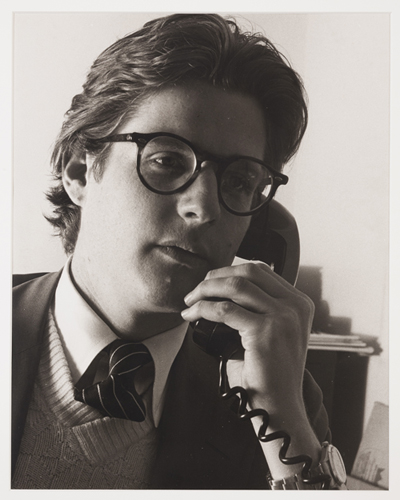
Vincent Fremont (c. 1978)
19. Fashion (1979 - 1980) is often considered the first cable TV series that you worked on with Andy Warhol. Generally, Warhol didn’t seem to have much contact with many of the “superstars” of his earlier films, but Taylor Mead, Viva and Jackie Curtis were in The Mudd Club Special of Fashion. Candy Darling, Brigid Berlin and Geri Miller had been in Phoney. What was Geri Miller like?
Geri Miller was a go-go dancer/stripper in Times Square and her personality was like her characters in Paul Morrissey’s Flesh, Trash and Women in Revolt. She was kind of spacey. She ended up going literally crazy by around 1980.
Andy’s idea for a cable TV show was it would be 1/2 hour on fashion, designers, etc. In 1979 as I was forming a production company and team, I asked Marc Balet, the then art director of Interview, who he thought would be a good choice to be a director of Fashion. He gave me the name of Don Munroe. I met with Don, and I told Andy we should hire him to be the director – he had experience shooting fashion and fashion shows and was working in Bloomingdale’s video studio. We hired Don.
Fashion was our first cable TV show from Andy Warhol TV Productions which appeared on Manhattan Cable Television, Channel 10. Not only was Don Munroe the director of Fashion, Andy Warhol’s TV and Andy Warhol's Fifteen Minutes, he operated the camera, meaning he shot most of the video footage. As producer I was backup cameraman when needed. It was Don who thought of the title, Andy Warhol’s Fifteen Minutes before we pitched it to MTV - Andy Warhol Productions’ first public access TV show that would be on Manhattan Cable Channel 10.
I asked Don what the best broadcast video camera was to buy, and it was an Ikegami valued then at around $40,000.00. Andy paid for the camera and all the equipment, Sony recording decks, Lavalier remote mics, Mole Richardson portable light stands, etc. It was a new challenge and as producer we worked with a very small team to make Fashion.
Don brought in an artist Sue Etkin to be the production manager. We had a few others as production assistants during shoots, it was a lean team. You could buy a half hour on Manhattan Cable Channel 10 for $75.00. You dropped off the ¾” master cassette of the show and you would be informed when it would be on cable. It was not unusual that our show would start a few minutes into the show because of sports programming and there was never any notice so you could not reach out to an engineer at the station.
20. Diana Vreeland was often considered the arbiter of fashion and good taste in New York - she was also in a 1980 episode of Fashion with Henry Geldzahler. Did you know Diana Vreeland very well?
Probably my favorite show of the Fashion series was The Empress and the Commissioner which was my idea for the title of the show. It was an interview with Diana Vreeland by Henry Geldzahler who was at the time the NYC Commissioner of Cultural Affairs.
I met Diana Vreeland through Andy and Fred. Diana adored Fred Hughes, and I spent several evenings at events seated next to her, she was so wonderful. I would go with Fred and Andy to her apartment, for champagne and I even took Diana on a date to see Chinatown - she was enthralled with Jack Nicholson.
21. Geldzahler died in 1994 at the age of 59 - still fairly young. Did Warhol have much contact with him in the 1980s?
My memory was that Andy and Henry always kept in touch after the 1960’s and when Henry became the Commissioner of Culture Affairs, Henry was even more in touch with Andy. We saw him a lot in social occasions and Henry came to lunch often at Andy’s studio. Henry and Andy were in touch with each other throughout the 1980’s until Andy died. Henry’s cousin John Reinhold became a close friend of Andy’s.
22. Fashion was followed by Andy Warhol’s TV. Again, so many interesting guests - Debbie Harry, Paloma Picasso, Halston, Zandra Rhodes, Studio 54, John Waters and Divine, Larry Rivers, Mariel Hemingway, John Hurt, Bianca Jagger, Philip Glass - there’s just too many to list - it’s like a history of the cultural scene in New York at that time. (The same could be said about Andy Warhol’s Fifteen Minutes). Were the guests paid a fee for appearing?
Don and I had a meeting and realized fashion was more than fashion shows and designers and Andy agreed. We expanded the idea that fashion is about culture, that included art, film, music etc. We decided the next group of shows would be entitled, Andy Warhol’s TV.
The first group of shows remained on Manhattan Cable Channel 10, then I made a deal with Madison Square Garden Cable TV (tri state viewership) with the help of Peter Rudge who oversaw non-sports programming. Peter was the tour manager for the Rolling Stones and other bands in the 1970’s and happened to reconnect with Fred Hughes and me around 1982.
Yes, we had so many different and interesting guests on the show with Andy as host and executive producer - the magnet that helped bring people to be on our show. There was no fee paid for being on the show, we had a shoestring budget! After Andy died, I had to cancel Andy Warhol’s Fifteen Minutes on MTV.
23. You were friends with Brigid Berlin and that could take up a whole separate interview. Pie in the Sky, which you directed with your wife, Shelly Dunn Fremont, is such a great movie. How did you meet your wife?
Brigid and I became close friends beginning in 1971. I met Shelly in 1976 when she was dating Larry Rivers!
Andy and Fred had met Shelly and her friend Ellen Burnie at a cocktail party and when Andy found out they worked at Bonwit Teller, (they were art directors) he invited them to dinner. Fred invited Shelly and Ellen to lunch at 860 Broadway, and I met Shelly.
It wasn’t until there was a screening of Larry River’s videos of his trip to Africa in 1975 (I was in Africa at the same time with Peter Beard, Larry, Barbara Allen, Kate Paley and I was videotaping as well) at the Automation House that Shelly and I started to be really interested in each other. A long story but Shelly and I got married in August of 1977.
24. Brigid was still alive when social media was gaining ground. Did she ever talk about it with you? In some ways she would be perfect for Instagram - except that her rants and raves might fall short of “community standards.” It must have been horrible when she died. It was strange - she was so paranoid about lung cancer and then she died from cardiac problems - I suppose still related to her smoking. Did she ever give up smoking? Where were you when you found out about her death?
Brigid had a hard time with computers and never really used them. She did get a cellphone but used her landline more. In the early to mid 1970’s I used to videotape her on the streets on Manhattan and at Andy’s studio. We did tests like ‘Breaking News,’ and she did a brilliant monologue about money, which is rarely seen. I had that video included in an AW exhibition at the National Gallery in Washington DC about 15 years ago and the end of the Money monologue, the punch line was censored!!
Brigid basically took to her bed after her younger sister Chrissy died. She started getting more and more conservative and her old Republican self came into focus. She was sober for many years but that ended I think soon after Pie in the Sky was released. We were invited to the 2000 Venice Film Festival to screen Pie in the Sky: The Brigid Berlin Story. She used to sneak booze into her apartment, and that is another long story. Her other sister, Richie, died on Brigid’s birthday, September 6, 2016.
I am happy to know you like the film, Brigid was so terrific and real! She never completely quit smoking and spent probably the last ten years of her life in bed. She became a big Trump fan! She stopped talking about her days with Andy and his world although she always loved him. In the last couple years of her life, she was in hospital emergency rooms often. Her one-time younger lover and neighbor in her apartment building Rob Vaczy took good care of her. It was the days of Covid, and I was in our home in Bridgehampton when I got the call from Rob that Brigid had died.
25. When did it become known that Fred Hughes had Multiple Sclerosis? He died after Warhol, of course, in 2001. Before that was he in a residential nursing home? It must have been so strange after his ‘dandy’ days - when he presented himself as almost aristocratic. Such a sad dichotomy.
In the early 1980’s Fred mentioned to Andy and me that he had tingling sensations in his hands and was going to see a doctor, I never heard anything more. It was soon after Andy died that Fred was diagnosed with Multiple Sclerosis, stress brought back the MS that had been in remission for years.
The first summer (1987) after Andy died Fred and I rented a house on Shelter Island, NY. Fred had symptoms of MS but they gradually got worse, enough for him to see a neurologist. We rented the house again the following summer and Fred was having difficulty walking and other issues. I think it was that summer Fred told me he had been diagnosed with MS as a child but then it went into remission.
Fred was in the hospital for long stays but lived the rest of his life at home, and after a few years hardly able to speak and wrapped up in sheets and blankets, totally bedridden. This a long story as well, Fred died in January of 2001. Fred was amazing and what a tragic ending.
26. I like the way you write about Warhol’s works - and wish there was more of it. Your introduction to the Eggs exh. catalogue, for instance points out how much work Warhol put into a simple image. Dudley Huppler, who Warhol knew in the 50s and 60s was also into eggs. Your explanation of Warhol’s process could equally be applied to other works like the celebrity portraits.
Wow, you read my essay in the Jablonka Gallery AW Egg painting exhibition catalogue! Andy was a great artist because he was a visionary, talented, creative man who looked at the world in an incredibly unique way.
27. What did you think of Warhol’s collaborations with Basquiat and others? Some writers have characterised them as a return to ‘real art’ after the commissioned portraits. (Did Warhol ever say ‘no’ to a commissioned portrait?) Other writers have characterised his collaborations as an attempt to remain current at a time when his art star was starting to droop. Other writers (such as myself) think they are pure genius.
I do not remember Andy saying no to a portrait commission, although he did return a portrait commission deposit for Dolly Parton’s portraits after her then manager, Sandy Gallin, let Andy know that he didn’t like the portraits Andy painted.
Andy and Jean Michel’s collaboration painting series was misunderstood by the art establishment. It was wonderful time for both, the creative energy was so apparent when the two of them were together. Andy was the older famous artist as mentor of an up-and-coming talented young artist. I commented on their relationship in an interview I did for a British documentary that was released soon after Andy died. Jean Michel called to thank me for explaining how close they were.
Under pressure from negative articles about their relationship, JMB did distance himself from Andy, something he really regretted after Andy suddenly died. You can read in Andy’s diaries Andy wondering why Jean Michel wasn’t calling him as much anymore. I think Andy’s death really affected JMB who died a little more than a year after Andy. The Collaboration paintings are wonderful, and they are finally getting their due.
28. When Warhol died (on February 22, 1987), it must have been such a strange period. You had only been in the Con Ed building for two years and then suddenly he was no longer there. Where were you when you found out? What happened to the building?
Andy’s death was a tremendous shock. I was so nervous when he went into the hospital on the Friday before he died. My worst-case scenario came true when I received a call from Fred Hughes at around 6:00-6:15 am Sunday morning that Andy died. I was in bed and dressed quickly in a suit and tie and met Fred at 22 East 33rd Street. I had the only copy of the Will other than the lawyers that drafted it - Fred as executor ( I was backup executor).
We decided to open Andy’s studio Monday morning but it was SAD and miserable that day, but we needed to keep working, we thought Andy would have liked that. There was plenty to be done, starting a Foundation, organizing the Estate, etc.
The Con Ed building changed hands a couple times then it was demolished to make way for a hideous tower of offices, maybe apartments. What a travesty!!
29. Was Warhol a kind person?
To me, Andy was like a second father, I learned so much from him. He was very loyal to those close to him at the studio and with many friends. We were in a way like his family.
30. Is it true that you had bought the rights to Tama Janowitz’ Slaves of New York? Had you obtained the movie rights on any other books?
Yes, Andy asked me to option the film/TV rights to Slaves of New York on his behalf from Tama Janowitz which I did. There were other books Andy was interested optioning when he went into hospital, but we never had the opportunity to discuss them and I can’t remember what the titles were.
31. When Slaves got made did you play a part in its production or casting?
Andy, me and Fred were supposed to be executive producers of the film but once Andy died, we (the Estate of Andy Warhol) sold the rights to Merchant/Ivory Productions and Fred and I became Associate Producers of the film, meaning we had no say in how Slaves should be made other than me showing Jim Ivory locations in Manhattan where some of Tama’s stories took place.
32. If there was one question you could ask Andy Warhol today, what would it be?
What do you think of the world now?
[end]
to page one