The Vincent Fremont Interview
by Gary Comenas
to page two
Vincent Fremont was the Vice-President of Andy Warhol Enterprises and the executive manager of the Andy Warhol Studio. During the 1970s and ‘80s he produced Warhol’s TV series and various video projects. After Warhol’s death he was one of the founding directors of The Andy Warhol Foundation for the Visual Arts, Inc. He was appointed the CEO of ARTNews in 2016 and stepped down a year or so later, remaining an adviser.
He and his wife, Shelly Dunn Fremont, also co-directed and co-produced the wonderful documentary on Warhol superstar Brigid Berlin, Pie in the Sky: The Brigid Berlin Story (2000).
He is currently working on a biography which includes the time he spent working for Warhol.
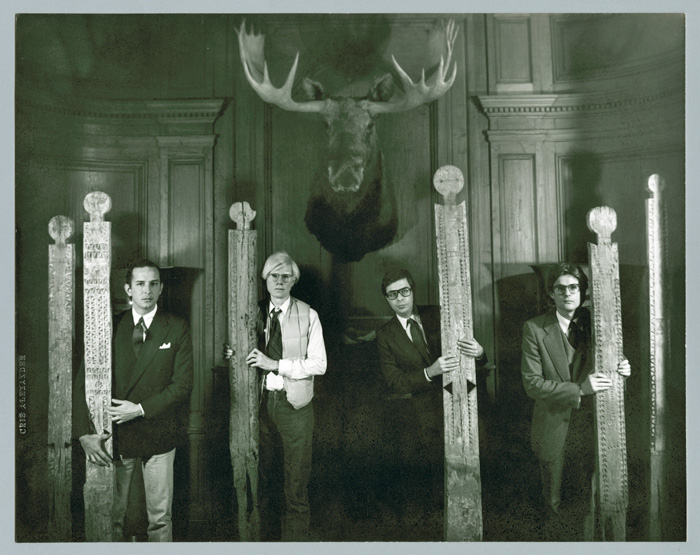
L to R: Fred Hughes, Andy Warhol, Bob Colacello, Vincent Fremont
(Photo: Cris Alexander in the conference/lunch room at 860 Broadway, c. 1978)
Gary: Researching this interview made me feel a bit depressed. I went through the Warholstars timeline and it seemed like the Warhol world was so much more interesting than today. I don’t think a lot of the books published in the 1960s for instance, would be published today due to “community standards.” Whatever happened to the “underground?” Do you find “Now” as exciting as “Then”?
Vincent: Yes, it is a different world now full of anxiety at least for me. Everyone always feels things were more exciting and interesting with past decades. In the USA it seems we have gone backward, becoming more conservative and judgemental. So many things we did in the 1960’s, 1970’s, 1980’s could not happen now. The annoying thing is that young people tend to look through the lens of ‘now’ when looking at the past decades to make their judgements.
2. I understand that you were born in San Diego and that your parents were artists, but in some accounts of your life, you grew up in Los Angeles. Were you a teenager in San Diego or L.A?
I was born in Ocean Beach, San Diego but my family moved to LA when I was around 5 years old - maybe younger. We lived for a while at the 'mouth' of Topanga Canyon. Then we moved into the first tract homes developed in Canoga Park in the San Fernando Valley because World War II vets could get a cheap mortgage.
From there we moved to Paris, France. We first lived in a hotel in Paris and then we moved to a small house outside of Paris in the town of Bures-sur-Yvette, so we lived in France altogether about 9-10 months.
3. Why Paris?
My father was searching for his mother who abandoned him when he was 4 years old at a spa some place in or around Paris. He tried getting work, but it proved impossible.
4. Did you meet other artists while you were living in France?
Because of our family friend Bill Copley (aka CPLY), I did get to meet Man Ray in his studio in Paris with my father and mother.
I also met Peter Saul (Bill was responsible for introducing Peter to my father) when my father took me with him to visit Peter at his home and studio in or near Bures-sur-Yvette.
Man Ray photographed my mother with his wife Juliette in San Diego before I was born.
5. What happened after you moved back to the States?
Up until about 1963 - 64 I was in LA. My parents divorced around that time, and I moved back to San Diego with my sister Monique and my mother. We were back in Ocean Beach.
6. Did you surf?
While finishing junior high school I traded my 10-speed bicycle for a crappy surfboard. I taught myself how to surf around the age of 15. We were living on a very tight budget, but my mother Catharine managed to save enough money to buy me a custom-made Gordon and Smith surfboard. The main beach I surfed at was Ocean Beach since I could walk there. I never had a driver’s license while living in California.
Another surfing spot I would go when I got a ride was on Point Loma at a place called Garbage - it had a break about a ½ mile out. After hitch-hiking, I would body surf with friends the serious shore break at Wind and Sea beach in La Jolla.
7. Were you around La Jolla when Andy Warhol was shooting San Diego Surf there?
I never met Andy and everyone when they were in La Jolla shooting San Diego Surf. I knew the son of the Judge that was putting Andy’s group up at a house and protecting them from the San Diego police department.
8. What were the names of your artist-parents?
My father was Robert Fremont. My mother’s first name was Catharine.
9. Your father was represented by Esther Robles. Do you remember anything about her or the gallery - or any of the other L.A. artists? What about the Ferus and Warhol’s Campbell's Soup Can show there? You would have been quite young, but do you have any recollection of how other artists (including your parents) or galleries reacted to that show?
Yes, for a short while in the early 1960’s my father was represented by the Esther Robles Gallery in LA. I don’t remember meeting Esther Robles - I would have been 11 or 12 years at the time. Because my parents were artists I was around a lot of artists. Yes, I was young, and I vaguely remember being aware of Andy’s Campbell’s Soup Can exhibition at the Ferus gallery since it was located on North La Cienega Blvd where the Robles gallery was.
10. What led you to be interested in Warhol? His art, his films or the NY lifestyle? What is your favourite Warhol film?
I can’t remember exactly why I started to really focus on Andy Warhol, his art, his world, the characters he surrounded himself with. It could have been my early exposure to his exhibition at the Ferus or just reading about him in the underground papers.
By high school I was following any news about him. I was too young to get in the Trip when the Velvet Underground played there, I had a crush on Nico. I saw some of his early films at Cinematheque 16 on the Sunset Strip, I had my father take me.
My father was ambivalent about Andy’s artwork, my stepmother Henriette did not like Andy’s artwork or what he represented. My mother Catharine liked Andy’s art and I introduced Andy to my mother and they became friends.
Like many people it was Andy and his world that made me want to leave LA and head for NYC. I do not like to pick favorites but all of Andy’s early films - silent and with sound - are still amazing. Of course, Chelsea Girls stands out and it did make it ‘above ground.’
11. A couple of your high school friends had connections to Terry Ork who, it is said, followed Warhol and his crowd back to New York after the filming of San Diego Surf. I think your friends took a trip to New York before you. Was it because of Ork?
After graduating from Point Loma High school in 1968 I started a group with my high school friends, Tim Sandoval and Michael Jaeger (who were both kicked out of Point Loma High School) and we called ourselves The Babies - this would have been the fall of 1968 or the beginning of 1969.
While in my high school senior year I interned at Theater 5 founded by Bob Glaudini who is a director, playwright. My two friends kind of helped occasionally. I painted flats for sets, did some sound for the productions, etc. We hung out at the Unicorn Cinema in La Jolla - it had a coffee bar and bookshop, and this was where we could find all the underground newspapers from LA, NY, etc. Terry Ork was around there, and we saw a lot of him then.
It would make sense (he was older) that Ork would have connected with Andy and others and then followed them back to NYC. That is maybe the reason Tim and Michael went to NYC before me. After they returned the 3 of us decided to leave LA and head to NYC in August of 1969. We had an ersatz manager, Chuck, drive us to New York in August of 1969 and we arrived the weekend of Woodstock. I met Andy in the first couple of days in NYC.
We arrived in NYC as The Babies and Mickey Ruskin, the owner of Max's, let us into his place for that reason - we had a 'look' and we were a group. We were introduced to Danny Fields (record executive and later co-manager of the Ramones) and Danny dubbed us the group that came from nowhere and did nothing - we looked like a rock band but we did not play instruments! We were a conceptual group.
12. After you went to New York, you returned to California for a bit. When you finally got back to New York, you made contact with Warhol again (or were you mostly involved with Paul Morrissey?). Were you in contact with Warhol or Morrissey before you returned i.e. was it planned that you would go back and help out at the “Factory?”
I had to leave NYC January of 1970 because of the draft lottery for the Vietnam War. My birthday was number 26 out of 365 days of the year. I knew I was going to get drafted, so I flew back to LA, my draft board was in Hollywood. Soon after arriving I received my pre-induction notice.
I got out of going to Vietnam and received a 4F after 2 days of tests and and physicals. Having very little money it took me until December of 1970 to get it together to return to NYC by car again, this time with a guy who worked with me at the same health food restaurant, Zap (in Silver Lake) and his girlfriend. I still didn’t have a driver’s license so I talked all the way to NYC to keep whoever was driving awake. We only stopped for gas and to use a bathroom. They were macrobiotics so brown rice, etc. was all we ate.
I quickly reconnected with Andy, Paul, and Fred in New York. Paul had to leave for Europe, so I moved back into Paul’s brownstone on East 6th Street to watch the place while he was gone. Andy asked me to work full time at his studio at 33 Union Square West in January 0f 1971. I had done some freelance work for him in the fall of 1969. No, I did not get in touch with Andy or Paul before returning to NYC, I contacted them once I was in NYC.
13. Was it even called the Factory then - or the “office” or something else? Which building was it when you first started working there? Later, when Warhol moved operations into the Con Ed building, how did they refer to the Con Ed building?
When I met Andy, the use of the word Factory was on the way out. By 1971 it was the Andy Warhol Studio. This studio was 33 Union Sq. West - it was the entire 6th floor. Andy had a private studio and storage in a group of rooms on the 8th floor and eventually Interview magazine had its offices on the 10th floor. In 1974 we moved Andy’s studio and Interview to 860 Broadway (3rd fl) located on the north side of Union Square.
The move up to the former Con Edison building 22 East 33rd/19 East 32nd Street happened in stages, and I am terrible with time frames. If I remember correctly, we moved Interview magazine up to the building first and their entrance was 19 East 32nd Street. Then Fred and I moved up leaving Andy and Brigid at 860 Broadway.
We had six months left on the lease at 860 Broadway and Andy and Jean Michel were able to complete more collaboration paintings.
Andy was the last to move up to the new studio. Andy’s studio entrance was 22 East 33rd Street. We also had a [158] Madison Avenue entrance that was rarely used - the first-floor room on that side became our video studio. The Con Edison space was referred to as the Andy Warhol Studio.
The renovation of the building was a nightmare because of the people Fred hired to do the job, and the contractor, Demos lost the use of the English language when you challenged him about mistakes. The building was T shaped and for tax purposes Fred and I owned 10% of 2 of the 3 wings - one wing each.
We moved our offline video editing studio/insert studio from 57 Great Jones Street to 22 East 33rd Street. Jean Michel Basquiat moved into 57 Great Jones Street.
14. Who was on reception of the Con Ed Building?
Brigid was still the main receptionist, and others took over from time to time. The reception desk was long and could accommodate two or three people.
to page two