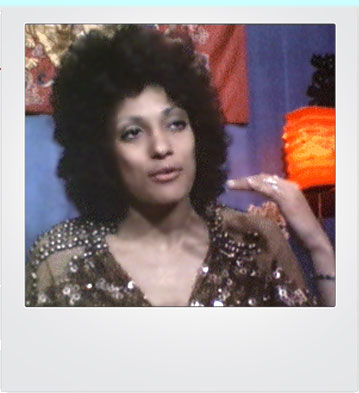
PAT HARTLEY

Pat Hartley
at the Factory
(photo: Stephen Shore)
Screen
Test
In addition to appearing in an Andy Warhol Screen Test in the Autumn of 1965, Pat Hartley also appeared in Prison with Bibbe Hansen and Edie Sedgwick and My Hustler II with Paul America. (AD89)
Hartley also appeared in several non-Warhol films including Double Pisces, Scorpio Rising (1970) Ciao Manhattan (1971), Jimi Hendrix Rainbow Bridge (1971), Jimi Hendrix (aka A Film About Jimi Hendrix) (1973) and Absolute Beginners (1986). (MG)
Double Pisces, Scorpio Rising was an experimental film directed by Hartley's husband, Dick Fontaine. When it played the New York Film Festival in 1970 Howard Thompson reviewed it for the New York Times.
Howard Thompson (NY Times):
"Toward the end of Double Pisces, Scorpio Rising, three people whimsically look in on a pig slaughterhouse, as the color camera bobs around, cinéma-vérité, catching their casual reactions to the commotion around them — the piteous squealing of the terrified animals who are dangled, butchered and quartered. Some of the close-ups of these poor critters are pips.
One of the human trio is Dick Fontaine, the director, a thin, long-haired youth who has put together this highly personal exercise on something or other that runs, mercifully, for 58 minutes and comes from an English group of movie folk called the Tattooists. The second visitor to the animal abattoir is a pretty girl. The third is a porky, middle-aged man addicted to the expression, "Ya know?"
The two men carry on a running argument about whether they should make a picture about pigs. "Are we making a movie, ya know?" says Fatso. "Where is it, ya know?" Then a bit later: "I'm making a movie about pigs, ya know?"
The pigs, the ones we see, don't stand a chance, ya know? Nor does anyone else who doesn't happen to know Mr. Fontaine personally and wonders what he's getting at. The first part shows smiling glimpses of Norman Mailer, in a neat suit and tie, amiably campaigning for Mayor. We see him riding the Coney Island roller coaster
Then we're off on Mr. Fontaine's own visual roller coaster, watching and hearing him inside a television studio as he chats and clicks his camera. At home he dials the phone repeatedly. He visits his childhood home and reminisces with a pensive woman portraying his mother.
The chapter also includes close-ups of the pretty model, Jean Shrimpton, reading a fable that implies soul-searching. And we see Mr. Fontaine again, this time crouched on the roof of what appears to be a school, assembling a machine gun. "The audience," he tells us, "waits for me to begin." Amen." (NYT4)
Fontaine, who first worked as a researcher at Granada Television in England, won a BAFTA award as one of the founding members of Granada's World in Action series in 1963. In 1995 he was made Head of Documentary at the National Film and Television School in Beaconsfield, Buckinghamshire, England. (http://www.nftsfilm-tv.ac.uk/)
Hartley and Fontaine ran Grapevine Pictures in New York - a film production company specializing in documentary, music and original drama. (www.nftsfilm-tv.ac.uk) During the 1980s they co-produced I Heard it Through the Grapevine (1982) and Man With A Mission - Art Blakey: The Jazz Messenger (1989).
Vincent Canby reviewed I Heard it Through the Grapevine for the New York Times when it opened at the Film Forum on March 3, 1982:
Vincent Canby:"Twenty years after the tumultuous civil-rights struggles in Birmingham and Selma, Ala., Atlanta and other parts of the South, James Baldwin, the novelist and playwright, revisited those cities as well as Washington, Jacksonville, Fla., and Newark in an attempt to get a fix on those events and on the progress made, if any, since then. The result is I Heard It Through the Grapevine, a free-form, feature-length documentary that hovers over its subject like a concerned parent who, not knowing quite what to make of things, expresses concern and sympathy." (NY Times, March 3, 1982)
Jon Pareles reviewed the Art Blakey documentary for the Times when it premiered at the Film Forum on October 28, 1988 as part of the Forum's Jazz Film Festival:
Jon Pareles:"From behind his drums, Mr. Blakey runs an elite jazz school, recruiting promising young musicians as Jazz Messengers and pushing them hard every time they step on a bandstand. He has honed young musicians, from Clifford Brown to Wynton Marsalis, in a career that now extends more than 50 years. The documentary presents Mr. Blakey working with an expanded band in London, then back in New York checking out possible Messengers at Sweet Basil in Greenwich Village and introducing a new group at Mikell's on the Upper West Side. It also shows musicians who worked with Mr. Blakey during the past six decades explaining his galvanizing effect; the trumpeter Dizzy Gillespie calls him ''the volcano.'' Mr. Blakey himself talks about his self-imposed mission to perpetuate jazz for the next generation. And sooner or later, none of his associates can resist imitating his gravelly voice.
The documentary's ratio of talk to music is rather high; none of the pieces are heard uninterrupted. Instead, there's always one more testimonial or anecdote, even atop rare archival footage of Mr. Blakey with the Billy Eckstine Band at the dawn of be-bop. To confuse matters, musicians and commentators aren't identified until the end of the film. Still, Mr. Blakey's indomitable energy comes through, on and off the bandstand." (NY Times, October 28, 1988)
Pat Hartley:
"It was the summer after I graduated from high school. I thought I was going to Hunter College, but I failed everything in high school, and now I was going to go to this hideous twilight session. I couldn't cope with it. So my friend and I went to have a drink in the Right Bank. The bartender was Tommy Goodwin, who was driving Edie [Sedgwick] around at the time... I think Chuck [Wein] had just come back from Europe; he had on this white suit. I think he'd just come from having a drink with the man who assassinated Rasputin, I remember that detail. Also with the guy who used to shoot drugs in his eyeball, William Burroughs - he'd been drinking with him... We ran into Chuck there a couple of times... I remember we used to go to - the Dom hadn't really opened yet - Stanley's Bar. We were hanging around the West Village. We'd just go sit in the 9th Circle... Then Stanley opened the Dom, and he had this fat jukebox, this ten-mile bar, just a dance joint on St. Mark's Place. I think we met there one night, and that was when Chuck took us to the Factory.
There seemed to be a lot of sex going on... What I saw at the Factory didn't freak me out because of what I'd already seen. It actually seemed like a world full of consenting adults... People showed up to do do whatever it is they wanted to do and got it done... I wasn't an artist, I'm not a painter, I always wanted to be a movie star. Suddenly the camera appeared, and oh, I thought, this will be an extra. The only reason I was there is that it was something special, something was actuallly happening, and that generated a lot of excitement... My feeling was one thought - a lot of things were going to happen, and I'm actually stunned at the things that didn't get made, the things that didn't happen..." (VY57-8)
Andy Warhol Warhol